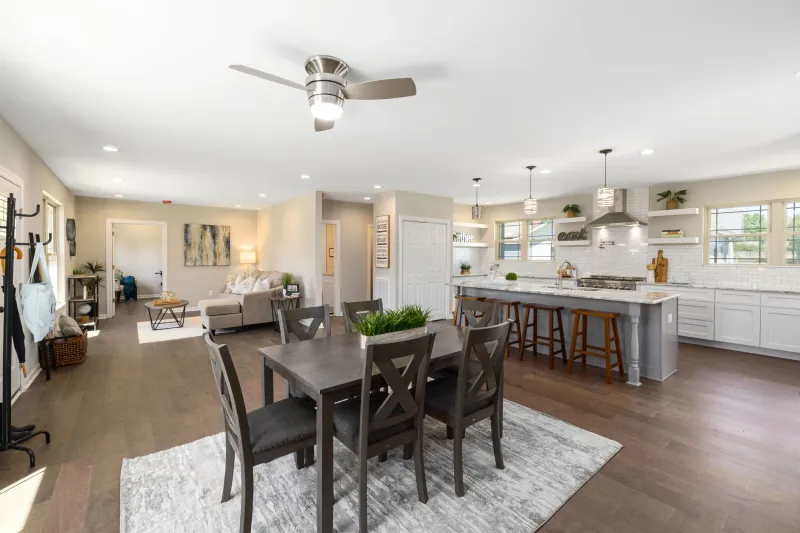
Five Honest Steps to Break the Analysis Paralysis Keeping You From Your Dream Home

Let's be candid about something the real estate industry rarely says aloud: a great many people who set out to buy a home never actually do—not because they lack the financial means or the motivation, but because they cannot stop thinking long enough to decide. They tour dozens of properties. They build elaborate spreadsheets. They lie awake running comparisons they have already run three times before. And then, almost inevitably, someone else makes an offer on the house they were still deliberating about.
If this pattern sounds familiar, you are not alone. Analysis paralysis in the home-buying process is genuinely common, and it is rooted in psychological dynamics that are entirely understandable. Purchasing a home is, for most Americans, the largest financial commitment of their lives. The stakes feel enormous. The variables feel infinite. And the fear of making the wrong choice—of settling for less than the imagined ideal—can quietly override the capacity to make any choice at all.
At Carrai Home, we have seen this dynamic play out repeatedly. What follows is not a set of platitudes about trusting your gut. It is a practical, honest framework for moving through the decision-making process with clarity and confidence.
Step One: Separate Your Non-Negotiables From Your Nice-to-Haves
The first and most essential step is a discipline that most buyers skip entirely: writing down, before you tour a single property, the difference between what you genuinely require and what you merely prefer.
Non-negotiables are features without which a home cannot functionally serve your life. They are typically few in number and highly specific. A family with two remote-working parents needs a minimum of two dedicated office spaces. A buyer with a mobility limitation needs single-floor living. A household with school-age children in a particular district needs to remain within that district's boundaries. These are structural requirements, and they should be treated as absolute filters.
Nice-to-haves are everything else. The chef's kitchen. The soaking tub. The south-facing backyard. The original hardwood floors. These features are genuinely desirable, and they should inform your preferences—but they should not carry veto power over a property that satisfies every true requirement.
The confusion of these two categories is the primary driver of analysis paralysis. When everything feels equally important, nothing can be evaluated clearly. Write the list. Enforce the distinction. Return to it every time a new property enters consideration.
Step Two: Define What 'Good Enough' Actually Means—And Respect It
Perfectionism is a significant obstacle in the home-buying process, and it is worth examining directly. The imagined ideal home—the one that exists fully formed in the mind of nearly every prospective buyer—is a composite. It assembles the best features of every home you have ever admired, adds several you have seen in design publications, and situates the whole thing in a neighborhood that may or may not exist within your budget. It is not a real property. It is a psychological construct.
This is not a cynical observation. It is a liberating one. Because once you acknowledge that the composite ideal is unattainable, you free yourself to evaluate real properties on their actual merits rather than against an impossible standard.
"Good enough" is not a concession. It is a decision made by a person who has defined their actual needs clearly and found a property that meets them. Research in decision science, including the work of Nobel laureate Herbert Simon, has consistently shown that "satisficing"—selecting the first option that meets a defined threshold—produces outcomes that are at least as satisfying as exhaustive optimization, and frequently more so, because they do not carry the cognitive and emotional cost of endless deliberation.
Define your threshold. Know what good enough looks like. When a property clears it, give yourself permission to proceed.
Step Three: Recognize FOMO as a Signal, Not a Fact
Fear of missing out operates in real estate as powerfully as it does in any other domain of modern life. You find a property you genuinely like, and almost immediately the questions begin: What if something better comes on the market next month? What if prices drop? What if this neighborhood doesn't develop the way I'm hoping? What if I haven't seen enough homes to know whether this is truly good?
These questions feel like prudent due diligence. In most cases, they are anxiety dressed in rational clothing.
A useful diagnostic: if you have toured more than fifteen properties within a defined search area and budget range, and none has met your criteria, one of two things is true. Either your criteria are misaligned with what the market can deliver—in which case the criteria need revision—or you are moving the goalposts each time a viable property presents itself. Both scenarios require honest self-examination, not more searching.
FOMO is most usefully understood as a signal that you care deeply about the decision, not as evidence that the right choice has not yet appeared. Treat it accordingly.
Step Four: Set a Decision Deadline and Honor It
Open-ended deliberation is the natural habitat of analysis paralysis. Without a defined endpoint, the decision process can extend indefinitely, accommodating every new piece of information and every revised concern without ever reaching resolution.
When you identify a property that satisfies your non-negotiables and clears your good-enough threshold, assign yourself a specific decision deadline—typically 48 to 72 hours in a competitive market, and no more than one week in a slower one. During that window, complete your due diligence: review the disclosure documents, consult with your agent about comparable sales, and if you have a trusted advisor whose judgment you value, seek their perspective once. Not repeatedly.
When the deadline arrives, make the decision. Not because the window has arbitrarily closed, but because you have given the matter the attention it deserves and further deliberation is unlikely to produce new information that changes the calculus meaningfully.
Step Five: Reframe the Decision as Recoverable
One of the most persistent cognitive distortions in high-stakes decision-making is the belief that the choice is irreversible—that selecting the wrong home will produce consequences from which there is no recovery. This belief is both understandable and factually incorrect.
Real estate is, by historical measure, one of the most resilient asset classes in the American economy. Homes can be renovated, refinanced, rented, or sold. Neighborhoods evolve. Circumstances change. The decision you are making today is significant, but it is not permanent in the way that the anxiety surrounding it suggests.
This reframing is not an invitation to be careless. It is an invitation to be proportionate. The cost of a suboptimal home purchase is real but manageable. The cost of years spent in indecision—the opportunity cost of equity not built, the emotional cost of a milestone perpetually deferred—is also real, and frequently underestimated.
At Carrai Home, we believe the home you have always imagined is within reach. More often than not, the primary obstacle is not the market. It is the willingness to decide. These five steps will not make the decision for you—but they will clear the path so that you can.